


Trespassing.
The Leading Cause of Rail-Related Casualties.
- Summer 2025
- Cranemasters
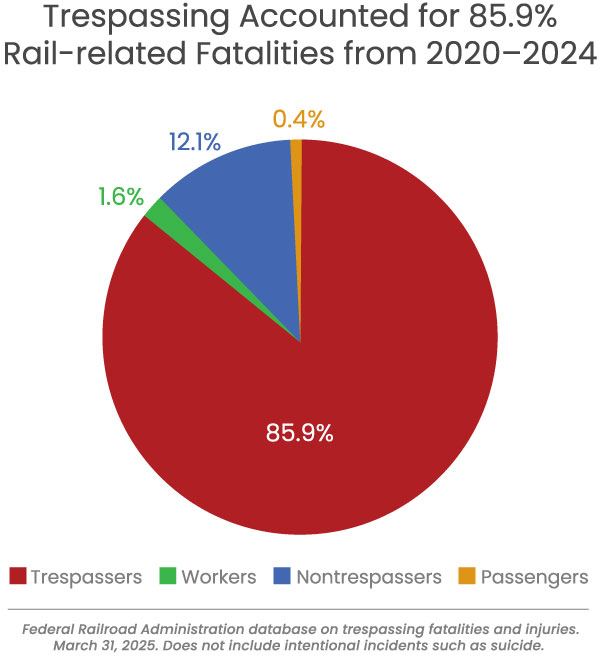
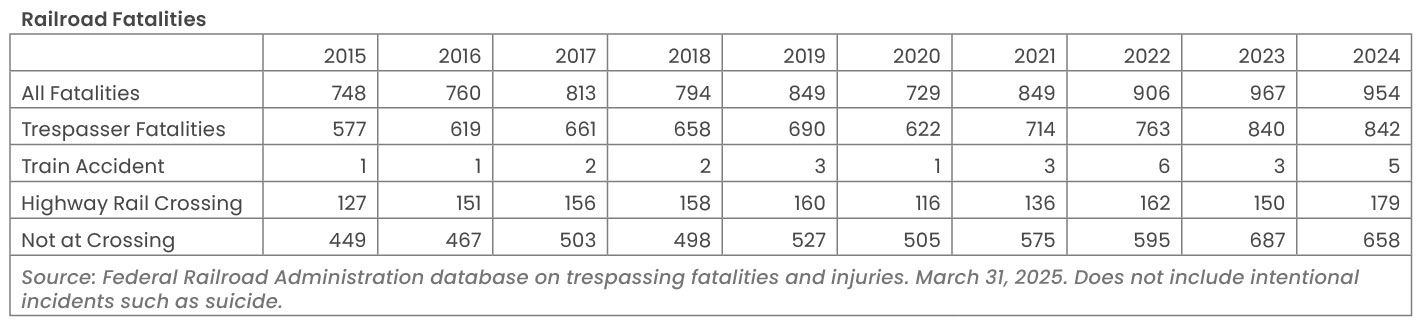
Trespassing is by far the leading cause of rail-related deaths in the U.S., accounting for more fatalities than derailments and collisions combined.
Railroad crossing accidents are the second leading cause of rail-related deaths in America. Together, 94 percent of all railroad fatalities and injuries are from trespassing and railroad crossing accidents combined, according to the FRA.5
 The Federal Railroad Administration defines trespassers as “persons who are on the part of railroad property used in railroad operation and whose presence is prohibited, forbidden, or unlawful.” Railroad property includes a railroad’s right-of-way, tracks, rail yards, facilities, train cars, locomotives, bridges, and trestles. All railroad property is private property, and crossing tracks anywhere other than a designated public crossing with a crossbuck, flashing red lights, or a gate is illegal in all 50 states.

A Glamorized Crime
Pop culture glamorizes trespassing by filming heart-pounding chases around moving rail cars. However, while movie stunt doubles can perform daredevil stunts on controlled sets, real people on real tracks get seriously injured and even die. Part of the challenge in preventing casualties is to dispel the movie-inspired notion of false bravado associated with trespassing along railroad rights-of-way and facilities.
The Impact of Railroad Trespassing
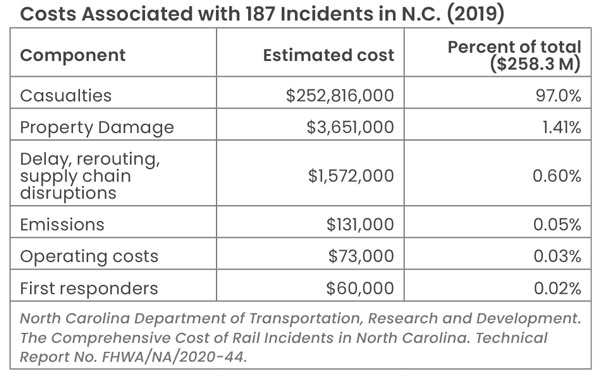
In addition to the loss of life or injuries, there are many direct and indirect costs associated with such an incident. These include damage to equipment, delays, rerouting, supply chain effects, emergency responder costs, emissions costs, and railroad operations costs. All too often, assessments underestimate the costs of railroad incidents, a situation that can lead to reduced resources for improving railroad safety. By accurately assessing the costs of an incident, it’s possible to make better decisions about how to allocate resources for curbing trespassing.
Nationally, 9,363 reported trespassing accidents from 2012 to 2016 cost society an estimated $43.2 billion in fatalities and injuries, according to the FRA—$41.2 billion for 4,291 deaths and $2.0 billion for 5,072 injuries.6
At the state level, North Carolina experienced 187 rail incidents between 2010 and 2019, resulting in an estimated $2.4 billion in costs to the state. Approximately $258.3 million was incurred in 2019, primarily due to the cost of casualties.7
Why People Risk Trespassing
It’s a convenient shortcut
Most pedestrian trespassers are taking a shortcut along the railroad tracks to their destination. Others are loitering or engaged in recreational activities, such as jogging, hunting, bicycling, or operating off-road, all-terrain vehicles.
Trespassers interviewed over a four-year period acknowledged that they knew they were trespassing and that it was against the law. They consciously decide to trespass because it is more convenient. In the same period, approximately 74 percent of trespassing casualties occurred within 1,000 feet—or less than a quarter of a mile—from a highway-rail grade crossing.6 Trespassers will climb or crawl over fencing and through cars of stopped trains rather than wait or walk to a designated area to cross the tracks. In one instance, a school official with children from the school was trespassing on a railroad’s right-of-way.
Because the number of reported close calls is much larger than the number of fatalities and injuries combined, the potential for additional casualties among trespassers is significant.
They Don’t Realize the Danger
Railroad employees receive extensive safety training and are aware of the inherent hazards associated with their work environment. Trespassers, on the other hand, do not. Nor are trespassers privy to the schedule of train movements, which can be in either direction at any time. They don’t appreciate the hazards of walking alongside or on railroad tracks, crossing anywhere except an authorized roadway or pedestrian crossing, and the risk of climbing on or moving between stationary cars.
There is a common misconception among the general public that they can hear a train approaching in time to avoid it. But despite their size, trains are relatively quiet and do not always sound warning horns when approaching.
The speed and distance of an oncoming train are difficult to gauge, and a train traveling at 55 mph can take a mile to come to a complete stop. Since rail cars overhang tracks by three or more feet on either side, there’s no room on a bridge, trestle, or in a tunnel for a trespasser to escape. Even if a train is idling at a complete stop, walking under, around, or between train cars is unsafe. The only sure way to avoid becoming a trespasser statistic is not to trespass.

Common Trespasser Characteristics
Identifying the intended audience for education is not always straightforward. For example, drivers—especially young drivers—are an identifiable audience for educating the general public about grade crossings. The locations of dedicated crossings are known. In contrast, trespassing can occur anywhere where there’s a track.
By comparing the demographic profiles of decedents with those of the national population and identifying significant differences, the FRA profiled the following characteristics and risk factors associated with railroad trespasser incidents.7, 8
Between 20 and 40 Years of Age
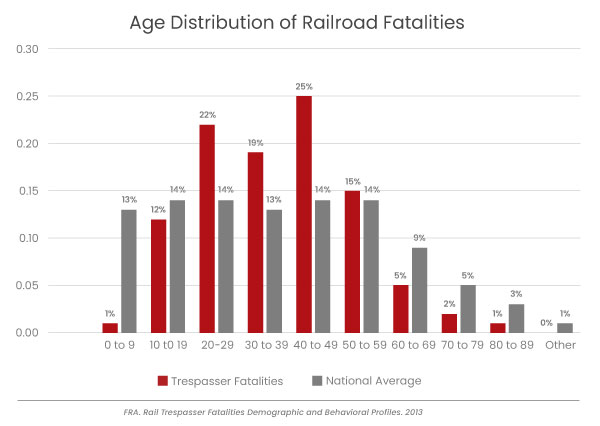
Trespassers who died in a railroad incident are much younger than the national average. The average age of death was 38 years, while the life expectancy at birth was 78.8 years. Two-thirds of trespassers were between 20 and 49 years of age at the time of death.8
Predominantly Male
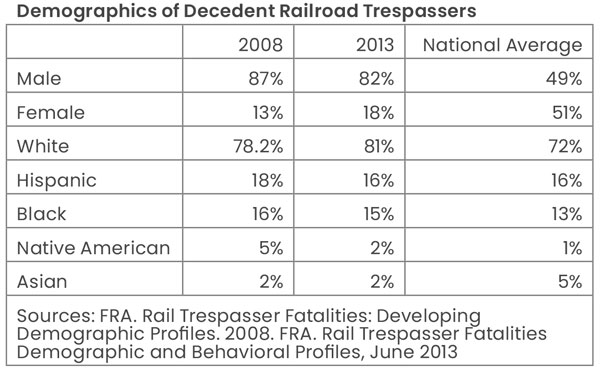
Railroad trespassers are likely to be male, who represented 82 percent of casualties compared to the national average of 49 percent. The proportion of their fatalities was highest between the ages of 20 and 49 years.8
In contrast, the 18 percent who were female were underrepresented compared to the national norm of 51 percent. However, when considering age for females, they had a higher proportion of fatalities under the age of 19 and over the age of 50 years.
Men are more likely to die from accidental causes than women. Nationally, men aged between 25 and 54 are 2½ times more likely than women to die from accidental causes. However, they were 4½ times more likely than women to be killed trespassing on railroad property. The high proportion of suicide-related railroad fatalities may account for some of the increased likelihood.
Casualties Tend to be Caucasian
Compared to the national average, Whites and, to a lesser degree, African Americans were overrepresented among railroad trespasser casualties. Other races were at expected levels based on the national. Though males remain predominant among fatalities, the male-to-female ratios for Whites and African Americans have decreased somewhat from the 2008 Report.
Employed with Low Income
Unemployment is not related to the occurrence of trespassing accidents. Most trespassing accidents occur in areas with unemployment rates similar to the national median rate.
That being said, married or unmarried, trespassers are more likely to have lower incomes and educational levels. Those who are overrepresented compared to the national average include younger renters in second-tier urban cities with railroads. Those with children are likely to be younger, typically in their twenties. A subset of trespassers are rural homeowners, who are often empty-nesters or couples with no children.
Examples of second-tier cities include Austin, TX; Charlotte, NC; Denver, CO; Minneapolis, MN; Nashville, TN; Orlando, FL; Phoenix, AZ; Portland, OR; San Diego, CA; and Seattle, WA.
Alcohol and/or Drug Use Is Prevalent
Alcohol and drug use are significant factors in many casualties. Testing confirmed that 52.4% of non-suicide trespassers tested positive for alcohol and/or drugs, 44% for alcohol only, 19.1% for drugs only, and 10.7% for both.8 Since 88 and 83 percent of 1,300 returned surveys from coroners and CMEs answered whether alcohol and drugs were involved, respectively, the actual rate of alcohol and drug use is suspected to be higher.

Handheld Electronic Devices Are Distracting
As of 2014, the Department of Transportation reported an increase in trespasser accidents involving the use of headphones or other electronic devices. Trespassers are increasingly distracted by listening to music, talking or texting on their phones, or taking selfies, as the use of electronic devices has increased significantly over the past ten years.
Pedestrian Trespassers Represent the Most Casualties
The types of incidents associated with railroad fatalities have mainly remained consistent over time. These included walking on, along, or across railroad lines, sleeping or sitting on the tracks, and using recreational vehicles.
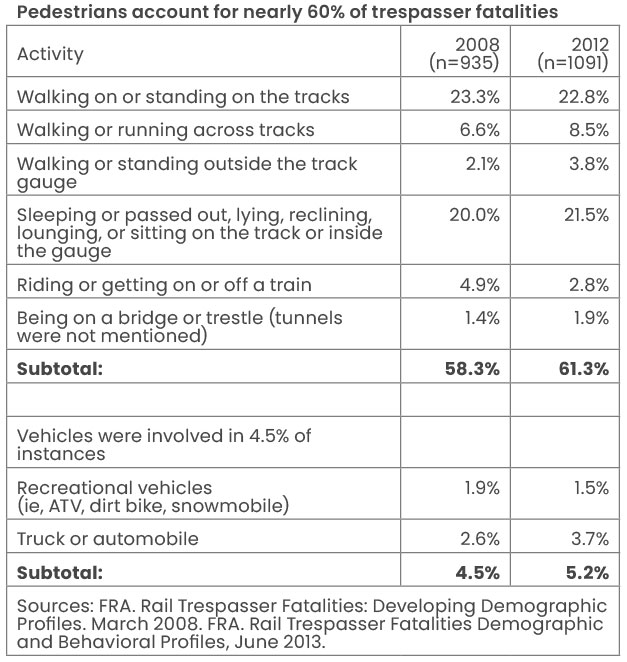
Slips, trips, and falls were common for trespassing casualties not at grade crossings, perhaps in part due to ballasted track over grade. The high incidence of fatalities that involve walking indicates that the majority of trespassing occurs in the vicinity of where they live. Overall, fatalities occurred in the decedent’s home state 93 percent of the time, 78 percent in their county.7
Suicides account for 20% to 25% more casualties
The Federal Railroad Administration (FRA) database on trespassing fatalities and injuries does not report suicides as casualties, per Title 49 Code of Federal Regulations, CFR Section 225.15. So, the following suicide data will inflate the number of trespasser casualties reported to the FRA. When suicides are included in the total for railroad fatalities, the 2008 and 2013 survey data suggest that approximately 25 to 30% of all railroad trespasser fatalities were the result of suicide.6,8 In the past ten years, there appears to be a downward trend in reported suicides from a high of 35%. However, the number of total trespasser fatalities has been steadily increasing over the same period.
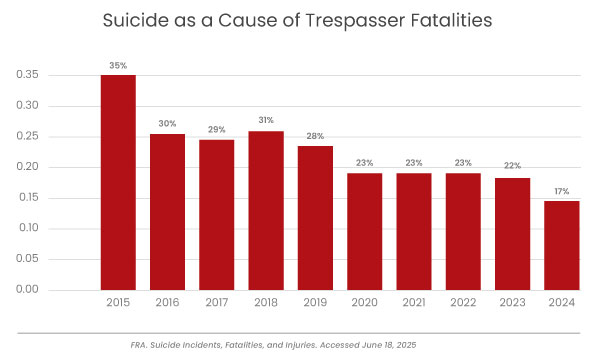
Fatalities for males 20 to 29 years old were disproportionately more likely to be suicides compared to the distribution of all male fatalities.8 For females, the proportion of suicides steadily increases through ages 50–59, with older female fatalities much less likely to be suicides.8
Drugs and alcohol use among suicides is less than that of other railroad casualties. Drugs and/or alcohol were involved in fewer than 40 percent of suicides. Alcohol alone was involved in 28 percent of confirmed suicides.8
Key Challenges
Train-pedestrian fatalities are concentrated in areas with a high population density and dense train traffic. Unsurprisingly, California, Texas, Florida, New York, Pennsylvania, Illinois, Ohio, and Georgia account for nearly 60 percent of all trespasser casualties during 2024. They represent the eight states with the highest population and six states with the highest number of rail miles.9,10,11
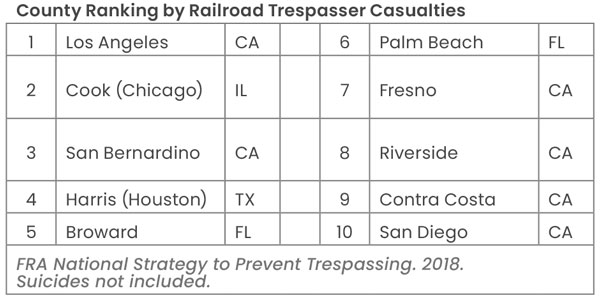
Of the approximately 3,100 counties across the U.S., ten with the highest number of trespasser casualties account for nearly 14 percent of trespasser casualties nationwide during the five years ending in October 2017.6 Each of these ten counties experiences some of the limitations that are common among all jurisdictions where trespassing occurs.
Limited Resources
In the ten counties where trespassing is most common, trespass casualties account for less than two percent of their homicides, drug-related deaths, or highway fatalities. Understandably, communities focus their limited resources, including local law enforcement, where the need is greatest. Consequently, the amount of personnel and funding dedicated to addressing railroad trespassing is insufficient. Congress provides funds each year for Operation Lifesaver, including $200 million from the Federal Highway Trust Fund for safety improvements at rail grade crossings.12 However, there is no similar program for preventing rail trespassing.Lack of Enforcement
While statewide and county penalties for trespassing on railroad property vary, it’s usually classified as a misdemeanor unless it causes an accident or poses a significant danger. Trespassers can be fined and arrested, but they are rarely prosecuted. For example, from 2013 to 2017, 1,080 railroad trespasser violations were filed in Cook County, with railroad police accounting for 1,034 of these. Yet, only 435 (40 percent) were prosecuted.6 In Harris County, 228 trespassing violations were issued, but only one was prosecuted.6 Ultimately, the lack of enforcement reduces the perceived negative consequence of trespassing.
 Different Trespassing Laws
“Permissive use” or “frequent trespass” exceptions can make it challenging to enforce trespassing laws. With these exceptions, if a sizable number of people have been allowed to travel on a railroad track at a location for a considerable amount of time, the railroad may be liable for injuries that occur at these locations. Some jurisdictions require the person on railroad property without consent to know that it’s railroad property to be charged with trespassing.
Other jurisdictions won’t address trespassing on private property unless their police department receives written authorization from the property owner.
Lack of Deterrents
Additionally, a lack of adequate physical deterrents—such as fencing and barriers that prevent trespassers from accessing a right-of-way—contributes to the ease of trespassing. Educational efforts on a local level have had limited success in changing the perception of trespassing on railroad property, evidenced by the upward trend in deaths and casualties.
Lack of Planning
Finally, poor community planning has a role. A lack of grade crossings in large spans of track contributes to trespassing. Locating public bus stops closer to grade crossings could make the designated crossings more convenient for pedestrians.
It’s also known that a lot of trespassing occurs near homeless encampments, shelters, food pantries, and schools. These are areas where a combination of efforts should be concentrated, including educational and directional signage, preventive fencing and barrier controls, monitoring and enforcement, and proximity to a safe crossing.
Ultimately, the goal is to allow pedestrians a safer, more convenient path to their desired location while creating significant deterrents to trespassing. Some railroads are having success using surveillance cameras mounted on locomotives or strategically located along a right-of-way to determine where to focus their efforts.
Locations of Higher Risk
In addition to individual and community considerations, specific location attributes can contribute to the likelihood of trespassing. These can be categorized as ease of access to right-of-way, poor visibility, and the opportunity to take a convenient shortcut. Pedestrians will seek to travel the shortest distance between two points—sometimes to go from one side of the tracks to the other.
Areas of Frequent Use Near Tracks
Trespassing “hot spots” include areas where people frequently visit that are near railroad tracks, especially apartment buildings, businesses, public buildings, or parks with parking lots separated by railroad tracks. There is often a “path” leading across the right-of-way.
Crossing Points
Multiple tracks have proven to be especially dangerous since the sound of one train can mask that of another approaching on a different track. As a result, people may wait for the first train to pass but not notice a second train coming from the opposite direction. Also risky are crossings with no early train warning system. The absence of lights, horns, or other warnings can increase the risk of people trespassing while a train is approaching.
Bridges & Trestles
Bridges and trestles are attractive to some trespassers. For example, if a pedestrian-accessible bridge isn’t available, a railroad bridge can serve as a shorter path to cross a waterway or roadway. Thrill-seekers and youths have jumped off bridges and trestles to go swimming or bungee jumping. There have even been attempts to land on top of a moving train passing below. It’s also not uncommon for trespassers to opt to walk across a railroad bridge with infrequent train traffic, rather than a parallel road that’s busy with motor vehicle traffic.
Tunnels
Tunnels may be attractive to certain trespassers, such as those seeking a shortcut or homeless individuals seeking shelter from the elements. People who trespass in tunnels and similar areas must go to greater lengths to bypass barriers, as these areas are generally well-protected with fencing and other deterrents. Tunnels often pose risks of electric shock and other hazards, in addition to the danger of being struck by an oncoming train.
Stations
At or near stations, there are hot spots for trespassing activity, especially those on curves. The lack of visibility increases the risk for people who are unaware that they shouldn’t be crossing the tracks. The proximity of stations to the right-of-way introduces a higher potential for accidents due to trespassing where they shouldn’t cross. Accidents also occur when someone slips and falls from a platform or onto the tracks while trespassing or comes into contact with electrical wiring.
Yards and Freight Terminals
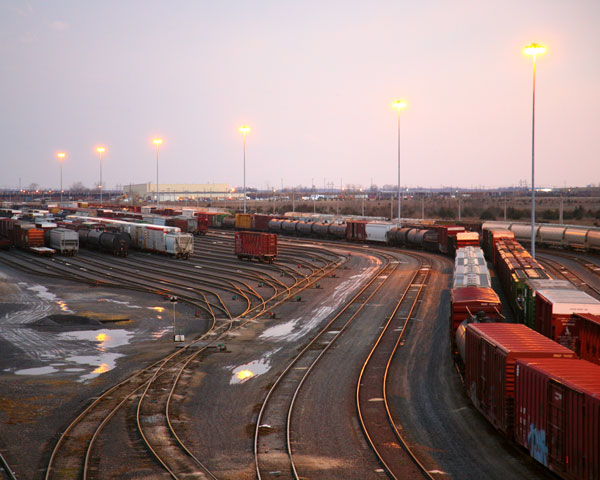
A significant number of trespassing accidents occurred in railroad yards, rather than on the mainline track. Often, trespassers are drawn to yards to steal cargo, scrap metal, or other items. At times, fatalities from climbing cars and other equipment, passing between cars—sometimes when the train is moving—were discovered later by employees who hadn’t realized an accident occurred.
Schools
Elementary, middle, and high schools are potential locations for children to be involved in rail accidents. They may wander onto railroad tracks near their school or walk along the tracks to and from school. Recorded accidents involving children have occurred between 7 a.m. and 9 a.m. and 2 p.m. and 5 p.m. It only makes sense to install considerable protection to preempt trespassing by children.
Summary
Trespassing affects all classes of freight railroads as well as public transportation, causing more deaths and serious injuries than any other type of railroad accident. While advancements have significantly improved the safety and reliability of railroad operations, the incidence of railroad-related casualties among trespassers has continued to grow.
Trespassing involves a conscious decision to bypass the railroad’s safety precautions in an unauthorized manner. Individual attitudes and behavior, along with social acceptance of trespassing, must be changed to decrease casualties from trespassing.
Education should focus on promoting behavior modification rather than merely raising awareness. Enforcement in jurisdictions with a trespassing problem can impose more serious consequences for those ticketed for railroad trespassing, much like authorities did to change perceptions about wearing a seatbelt. Railroads should continue to identify and invest in methods to monitor and deter trespassing. By developing coalitions to pool resources and combine these efforts, it may be possible to make trespassing a less appealing option for those who would otherwise consider it.

Sources:
- “Commuter Rail. Most Systems Struggling to Recover Ridership Following Covid-19 Pandemic.” May 2025. GAO.gov. Accessed July 3, 2025. https://www.gao.gov/assets/gao-25-107511.pdf
- Amtrak Media Center. “FY24 Year End Ridership.” December 3, 2024. Amtrak Media Center. Accessed June 13, 2025. https://media.amtrak.com/2024/12/fy24-year-end-ridership
- “U.S. Ton-Miles of Freight.” Bureau of Transportation Statistics. Accessed July 3, 2025. https://www.bts.gov/content/us-ton-miles-freight
- Fatalities, Injuries, and Illnesses in Train Accidents, Highway-Rail Incidents, and Other Incidents (4.08). U.S. Dept. Transportation. March 31, 2025.
- “Highway-Rail Grade Crossing and Trespassing Research.” FRA. Accessed July 3, 2025. https://railroads.fra.dot.gov/research-development/program-areas/highway-rail-grade-crossing/highway-rail-grade-crossing-and
- FRA. “Report to Congress. National Strategy to Prevent Trespassing on Railroad Property.” 2018. FRA. Accessed June 15, 2025. https://railroads.dot.gov/elibrary/national-strategy-prevent-trespassing-railroad-property
- “The Comprehensive Cost of Rail Incidents in North Carolina. Technical Report No. FHWA/NA/2020-44.” North Carolina Department of Transportation, Research and Development. Accessed July 3, 2025. https://connect.ncdot.gov/projects/research/Pages/ProjDetails.aspx?ProjectID=2020-44
- “Rail Trespasser Fatalities: Developing demographic profiles.” March 2008. U.S. Dept. of Transportation. FRA.
- “Rail Trespasser Fatalities Demographic and Behavioral Profiles.” June 2013. U.S. Dept. of Transportation. FRA.
- “U.S. States—Ranking by Population 2025.” worldpopulationreview.com. Accessed June 12, 2025. https://worldpopulationreview.com/states
- “Freight Rail in Your State.” Association of American Railroads. Accessed June 12, 2025. https://www.aar.org/states
- “Trespassing Casualties by State.” Operation Lifesaver. Accessed June 17, 2025. https://oli.org/track-statistics/trespassing-casualties-state
- EveryCRSReport. “Trespassing: The leading cause of rail-related fatalities.” August 15, 2017 to February 2, 2018. EveryCRSReport. Accessed June 18, 2025. https://www.everycrsreport.com/reports/IN10753.html