




Gear Up Like Your Life Depends on It. It Does.
- Summer 2025
- Cranemasters
Ask any railroader, and they’ll tell you that safety is the industry’s number one priority. And for good reason. The railroad work environment is inherently hazardous, and working conditions are often challenging.
To safely perform tasks related to railroad construction, maintenance, or repair, workers receive extensive safety training and wear Personal Protection Equipment (PPE).
Innovations in heavy-lift equipment and safe practices have also contributed to the very low fatality rate among railroad employees, as well as a 60 percent drop in employee injuries over the past two decades.
PPE serves as the last line of defense against injury, and proper selection and use are essential for railroad workers. Railroad companies and contractors must follow Federal Railroad Administration (FRA) guidelines for providing workers with the correct PPE and training on its proper use. Workers must use PPE when required, and only as intended by the equipment. Anyone entering a designated area or working near others wearing PPE must also wear the necessary PPE.
The equipment needs to fit correctly, be maintained in good condition, and be replaced when necessary to ensure it can provide the intended protection. It shouldn’t be altered or used if it has been changed. Overall, PPE is a crucial component in preventing injuries and protecting workers in challenging and hazardous environments.
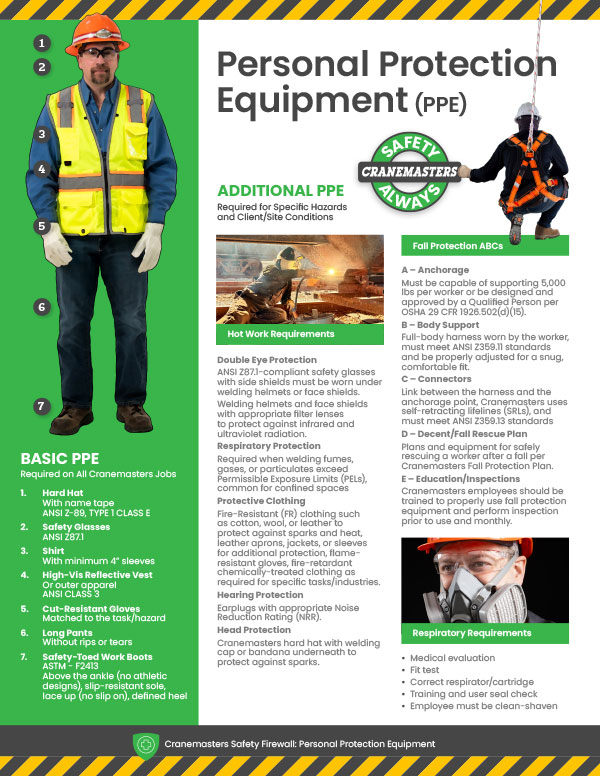
The Cranemasters Safety Firewall program includes posters such as this one for PPE throughout work areas.
Top 12 Reasons to Wear PPE
- Railroad construction can expose workers to a variety of hazards and risks that employers and workers need to consider when choosing and using personal protection equipment, including:
- Movement of trains, heavy equipment, and vehicles on the track or site
- Working at height over bridges, elevated tracks, or cargo cars
- Falling objects, slippery surfaces, uneven ground, and tripping hazards
- High-voltage electricity and working near overhead power lines or substations
- Chemical burns and Hazmat exposure
- Welding sparks and flying debris that can damage eyes
- Loud noises that can damage hearing
- Adverse weather conditions, such as high humidity, rain, snow, fog, or reduced visibility
- Physical strain and musculoskeletal injuries from repetitive or stressful tasks
- The risk of dehydration, heat exhaustion, stroke, or frostbite
- Fatigue and impaired alertness from long hours or lack of sleep
- Human error and lapses when operating equipment or following safety protocols
Selecting PPE
When selecting PPE, wearer comfort, durability, and safety are important considerations. Meeting or exceeding regulatory standards is also critical to protecting workers’ long-term health, well-being, and productivity. The following is a brief introduction to standard PPE for railroad workers.
Head Protection
Whenever there is a risk of a head injury, workers must wear a safety helmet or hard hat. They protect wearers from falling objects from above, stationary objects, and lateral impacts, as well as potential head contact with high heat and electrical hazards, and from falls. Failing to provide a worker with a hard hat or permitting work without a hard hat when one is required is a violation.
Cranemasters uses the BUL-C33HOR hard hat, Type 1, 6 Point Rachet Suspension, Full Brim Hard Hat, Ratchet Knob, Hi Viz Orange, ANSI Z89.1-2014 compliant, Class E, G, and C.
According to OSHA standards for head protection, there are two types of hard hats based on their impact protection.
Additionally, there are three classes of protection from electrical hazards.
Class C (Conductive) head protection is not designed to protect against contact with electrical hazards.
Class G (General) head protection is proof tested at 2,200 volts to protect against reduced exposure to low-voltage conductors.
Class E (Electrical) head protection is designed to reduce exposure to higher voltage conductors and is proof-tested at 20,000 volts, phase-to-ground.
Workers performing hot work like operations that involve producing heat, sparks, or open flames, need to wear a welding cap or bandanna underneath their hard hats to protect themselves from sparks.
Hard hats are not to be worn with baseball caps or similar caps or liners that interfere with their fit or function. People indoors, in vehicles, or in equipment that provides overhead protection are exempt from wearing a hard hat.
Eye and Face Protection
When working in any construction environment, it’s necessary to wear company-approved safety glasses or FDA-approved prescription safety eye-wear that covers the entire eye or coverall-type safety goggles. All Cranemasters’ jobs require wearing ANSI Z87.1-compliant safety glasses with side shields. When performing hot work, personnel must wear protective eye-wear, such as welding helmets or face shields, that have the appropriate filter lenses to shield against infrared and ultraviolet radiation.
You should not wear contact lenses in the presence of wind, dust, or other foreign matter or when there’s the potential of chemicals or welding materials to pose the risk of splashing, misting, fumes, or vapors.
Aside from being impact and scratch-resistant to protect against impacts and debris, the safety eye-wear lens should not alter the perception of red, yellow, and green signal colors. Peripheral visibility, 100% UV protection, anti-fog, and anti-static properties are also important.
Hearing Protection
Between 70 and 80 decibels is considered the threshold separating sounds that are safe from those that are harmful to your hearing. Prolonged or repeated exposure to sound above 85 decibels can cause hearing loss. The higher the decibels, the shorter the exposure time before hearing damage may occur. Not only is working beside train tracks loud due to the passing trains, but also from the machinery and equipment used for the work. To avoid occupational hearing loss, there are times when railroad workers should wear earplugs with an appropriate Noise Reduction Rating (NRR), ear muffs, or both. For example, hearing protection should be worn when:
- 50 feet from a locomotive, retarders during operations, roadway or work equipment operating, jet blowers, or pile drivers.
- 15 feet from cutting or welding equipment, wheel grinders or sanders, chain saws, nail guns, power saws, equipment powered by air, combustion engine, electricity, hydraulic, pneumatic, and operating lift or transfer equipment
When the working environment impairs communication and, consequently, the safety of operations for workers, there are protective communication headsets that safeguard hearing while facilitating communication along with hand signals.
Hand Protection
Comfort, fit, and dexterity are essential, especially when working with your hands for extended periods. Functionally, safety gloves provide a secure grip while protecting against cuts, lacerations, abrasions, and punctures. They also protect against high heat and chemical burns. Additionally, impact-resistant safety gloves absorb and redistribute energy away from the fingers and hands during impact.
There are different types of PPE gloves for railroad construction work, including standard gloves, thermal gloves, and welders’ or electricians’ gauntlets. The specific work indicates the type of protection required.
Respiratory Protection
With many railroad construction projects, there may be welding fumes, gases, or particulates. Respiratory protection is always required when exposure exceeds Permissible Exposure Limits (PELs), a common occurrence in confined spaces. But even outside, respiratory protection may be necessary. For example, microscopic particles of ballast dust released into the air are a significant hazard of railroad construction or maintenance, as exposure to them can result in workers inhaling silica particles. Exposure to silica can lead to long-term health problems. Typically, in the form of a mask with a filter, respiratory PPE protects the worker’s lungs from exposure to harmful particles stirred up during the project.
In addition to users being clean-shaven, respirator use includes the following requirements:
- Proper respirators and cartridges must be selected to filter out the specific hazards that need to be addressed.
- A medical evaluation is required before being fitted for a respirator, even if it’s to be used once for a short time.
- Training and properly putting on and taking off the respirator according to the manufacturer’s instructions.
- An annual fit test is required to ensure that the respirator size and fit form a tight seal on the wearer’s face.
- A seal check (also called a fit check) should be performed before every use to ensure a proper seal.
User seal tests are done with either positive or negative pressure, depending on the respirator and manufacturer. With positive pressure, the user gently exhales while blocking air from exiting the face-piece. With negative pressure, the user inhales sharply while blocking air from entering the face-piece. A good seal with positive pressure will cause the face-piece to pressurize slightly before increased pressure causes outward leakage. With negative pressure, the face-piece will collapse slightly.
Clothing
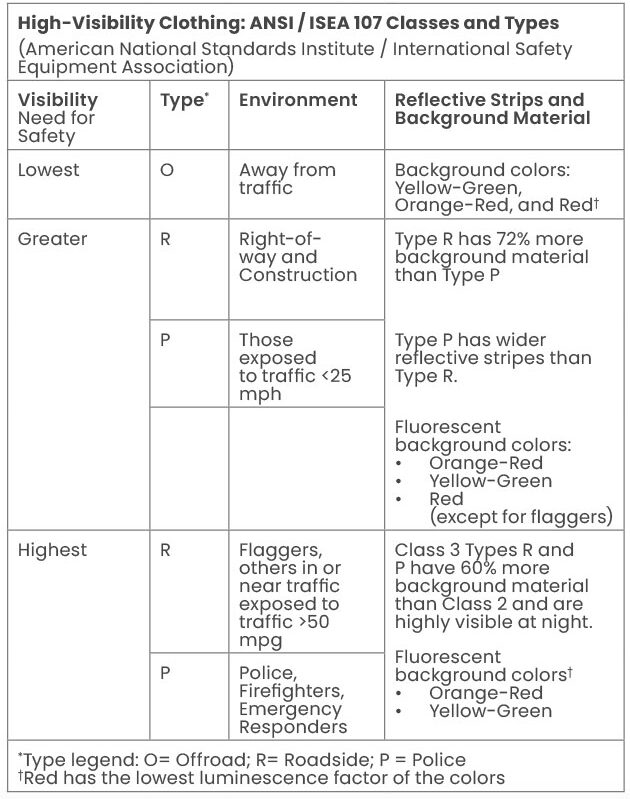
Wearing high-visibility safety clothing is mandatory for railroad workers who operate in areas with moving trains and heavy machinery. They must wear a yellow or orange ANSI Class III vest or other outerwear with reflective striping—designed to provide 360° visibility in dark, hazardous conditions. It offers the most visibility of the three classes and three types of high-visibility clothing, as specified in the ANSI/ISEA-107 standard.
The following is a brief overview of ANSI/ISEA 107 classes and types. Always choose the higher-class product if you’re unsure which to select, or confirm with OSHA which one is the appropriate choice.
In general, high-visibility vests and outerwear should be waterproof, metal-free, and feature reflective strips. Garments are specific to job requirements and may require protective and fire-resistant (FR) clothing such as cotton, wool, or leather to protect against sparks and heat; leather aprons, jackets, or sleeves for additional protection; fire-retardant chemically treated clothing; and/or flame-resistant gloves, depending upon the nature of the job.
Clothing can’t interfere with vision, hearing, freedom of movement, or the use of hands or feet. Hooded sweatshirts and other clothing that can block peripheral vision are not allowed, nor is outerwear that can easily snag on something. Long pants are required, and when the entire body needs to be visible, high-visibility trousers are available.
Fall Protection
Falls are the leading cause of injury at most worksites. To prevent injury, the FRA requires companies to provide workers with a fall arrest system or a safety net system whenever they are working twelve feet or more above the ground or water surface. The twelve-foot standard provides the necessary fall protection for railroad employees working at heights while allowing sufficient movement to complete the task.
A worker wears a full-body safety harness attached to a lanyard or self-retracting lifeline (SRL), which is secured to an anchor for support. Together, they form the ABCs of a fall arrest system.
Training on how to use fall arrest systems is essential, as they are an active form of protection.
Wearers need to use fall protection equipment properly, inspect it monthly and before each use, and be familiar with the safety procedures. A Fall Rescue Plan is required to equip employees with step-by-step procedures in the event of a rescue.
The ABCs of Fall Protection
Anchorage, Body Support, and Connection. Meeting OSHA and ANSI safety standards.
Anchorage
The anchorage is the attachment to an approved, stable surface that is strong enough to support a person, such as a bridge component. It must be independent of the means of work, located at a height that will not allow free fall greater than 6 feet, and positioned to minimize swing fall hazards. Finally, it must be capable of supporting 5,000 pounds per worker attached or be designed and approved by a Qualified Person per OSHA 29 CFR 1926.502(d)(15).
Body Support
A full-body safety harness is the only approved option for those working in fall arrest. They must meet ANSI Z359.11 standards, distributing the fall throughout the body and suspending the person upright after a fall. They must limit the maximum arresting force to 1,800 pounds and include a keeper to control the ends of any dangling straps. Finally, they need to be properly adjusted for a snug, comfortable fit.
Safety belts are no longer acceptable because they concentrate the entire force onto one area of the body, and workers can slip out of them.
Connectors
There are two key types of connections between the anchorage and full body harness—each used for different situations.
A safety lanyard is a set length of rope, wire rope, or webbing strap designed with an internal or external shock-absorbing feature that decelerates the worker to a stop in the event of a fall. Self-retracting lifelines (SRLs) retract automatically into a housing unit, eliminating slack in the line.
Cranemasters use an SLR with a minimum tensile load of 5,000 pounds per ANSI Z350.13 standards. Because SRLs are longer than lanyards, they offer greater mobility and are appropriate when the fall clearance varies. In the event of a fall, the fast-acting braking mechanism in the housing unit arrests the descent.
Safety Footwear
Workers on even surfaces and in all kinds of weather conditions depend on safety footwear to prevent slips, trips, and falls. Safety footwear designed for rough, outdoor environments features broad soles and deep treads for stability and protection, as well as waterproof materials, metal-free options, and reflective elements for visibility. Besides the correct size, lightweight and breathable materials with shock absorption can make safety footwear comfortable, even when you’re on your feet all day.
Safety boots for the railroad industry must meet specific safety requirements, as defined by OSHA Standard 1910.136, ANSI Z41.2, ASTM F-2412-11, ASTM F-2413-11, and Standard Class #75 for safety toe footwear.
Safety Toe Footwear Considerations:
- Must cover the ankle (no athletic designs)
- Boot height should be at least 6 inches for men and 5.5 inches for women, measured from the floor to the top of the boot
- The measurement of any part of the collar cannot be less than 4.5 inches
- Must also be laced up (no slip-on boots)
- Have a defined heel
- Have slip-resistant soles that provide good traction and are thick enough to withstand punctures
- Have corrosion-resistant steel toe caps or non-metallic toe caps for heat and chemical exposure
- Drop test at 200 joules of test energy (20 kg from a height of approximately one meter)
- Static pressure test at 15 kilonewtons (approximately 1,500 kg of pressure)
- Resistance, non-toxicity, and properties of the materials used in the sole and shoe upper
Wear Your Gear. Your Crew is Counting on You.
Safety measures aim to prevent harm before we encounter hazards—by relocating or replacing dangers, isolating workers, or modifying the work environment to reduce risk. However, when these controls aren’t enough, personal protective equipment (PPE) is the final barrier between you and injury. Consistent proper use of PPE is essential to keeping you and your team safe on the job.